Showing posts with label early modern. Show all posts

Thursday, December 12, 2013

Commissioning a Helmet Across the Border

On April 17th, 1560, Murad the Ottoman janissary aga of Buda, wrote a letter to István Dobó thanking him for the delivery of a set of helmets he had commissioned for the amount of 25 gold thalers. After expressing his eagerness to return the favor, he sends his regards to another individual and proceeds to brag about sultanic gifts to his supervisor and his own promotion to head aga. Along with his payment, he also sends Dobó a wedding gift in the form of a blue Persian carpet. Signing with "God bless you" and dating it using the Christian calendar, our sixteenth century Muslim military official seems to wield both the Hungarian language and a cosmopolitan understanding of religious difference. One is hard pressed to find even the slightest trace of the clash of civilizations that characterizes much of the literature on this border region in the mid-sixteenth century. 

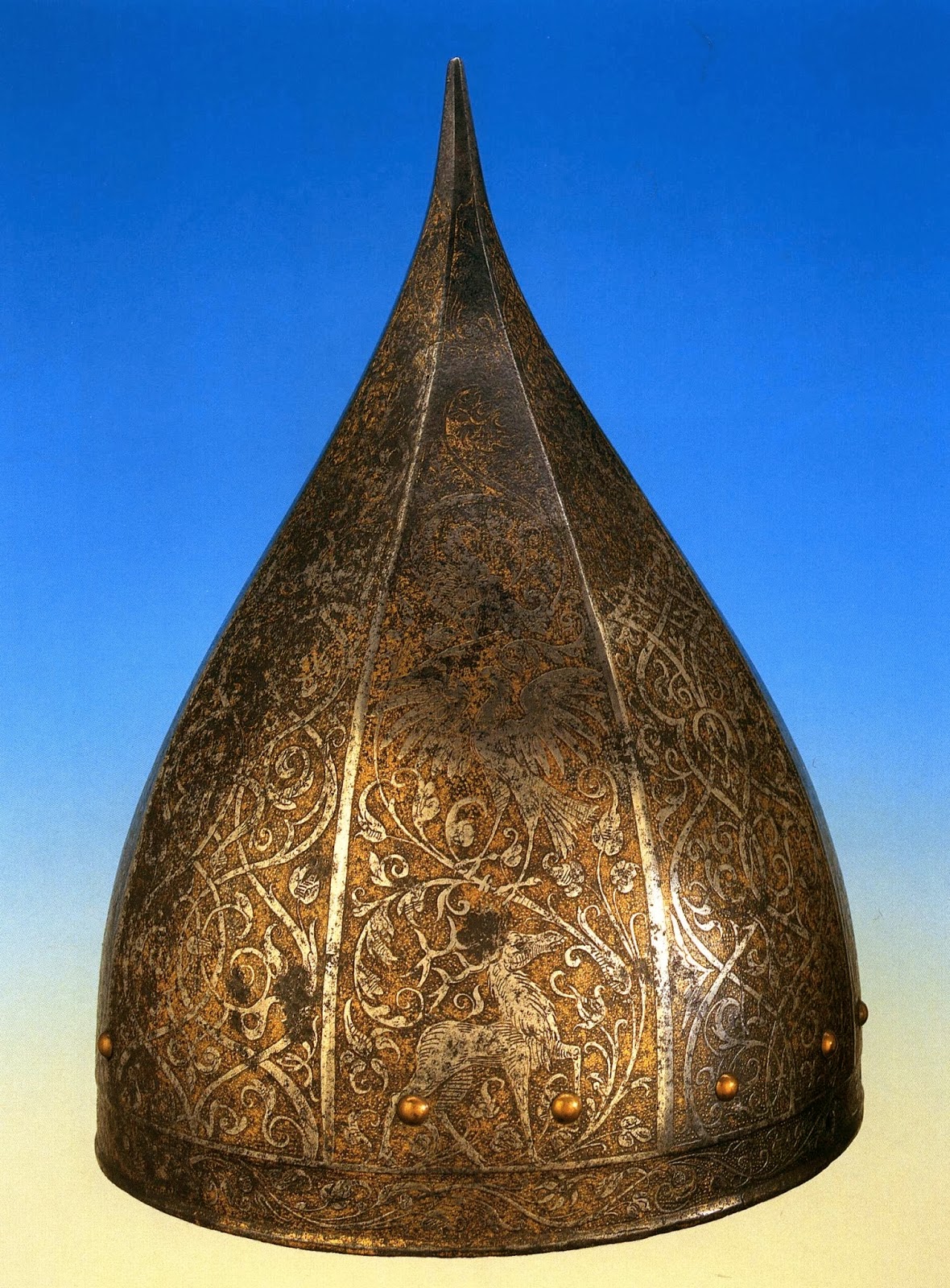
The helmets commissioned were likely of the "Ottoman" type: bulbous bowls that rose to a point with a row of holes along the bottom rim used for attaching the accompanying plate or mail neck and cheek guards, occasionally with a long nose guard in the front topped by a decorative piece of metalwork bearing an inscription. These "turban helmets" varied widely in decoration and were produced throughout the region, both in Ottoman and Habsburg lands. A number of the surviving examples bear armorer's marks from Nuremberg. I am currently in the process of collecting references to similar commissions and hope to have a more detailed and comprehensive post on them soon. Until then, I have attached my translation of the document below, along with the original and some examples of similar helmets. 


Translation:

"Greetings to you sir, my good neighbor. They gave me the two helmets which you sent me for my money. Thank you for your service my sir. I promise you that if you should ask for anything of this type from me, I will acquire it for you. Do not send me money bravely just to tell me what you want, as I can find the money later with you. I sent you the price of the helmets: 25 gold and new thalers, which should cover the price of the helmets. Send my greetings/thanks to Sir Domokos. The great emperor [sultan] gave Wely Szu Pasha [should be referring to Güzeldzse Rustem Pasha] 52 thousand in cash as a present, and also a beautiful horse with fittings. On top of that he also gave the head janissary of Upper Turkey the appointment of head aga. Please accept the beautiful blue mahraman I have sent you as a wedding present. Please send me a response assuring me that you received all of the money and the mahraman. May God bless you. Written in Buda, on Easter Wednesday 1560.

Murad, Janissary Aga of Buda"

Exterior: "Give this letter to the gracious Dobó István, my sir and good neighbor."


"Köszünethemet mynt yo szomszed vramnak. Meg attak a kett sysakot kiket keg ennekem kẅldött penzemre Köszönöm kegdnek szolgalattyait mynt vrammnak: yghyrem ismeg magamat hog kegmed valamire engemet ker e fele dolognak meg szerzesere meg szerzem kegdnek. Keged ennekem bator penszt ne kẅlgyon czyak hog kẅlgi hyrt mytt kewansz  meg szerzem kegdnek a penzt az vtan enis meg talalom kednel. Meg kẅltem az szsakoknak az arrat kegdnek: 25 aranyatt es uj tallert, mely az szsakok arrat szynte meg teszy. Damokos vramnak keged en tölem mongyon köszömtetett. Wely Szẅ passanak az haralmas chyaszar 52 ezer orzporatt adott kesz penzẅl azandekon. Ismeg egy fö loẅat mynden szerewel szamaẅal, Annak felette a felsö török orszagba az fö janczyar aga vtan fö agasagot. Kẅldöttem te nads azandekon egy igen szep kék mahramant kit keged vegyen yo newen tölem. Mynd a penz felöl smynd az mahraman felöl en nekem byzonnyos valaszt tegyen keged ha meg attake veg nem. Isten tarcza meg kg : Költ Budan Hẅswet szerdan anno 1560.

Mẅratt janczar aga 
buday"

exterior: "Adassek ez lewel az Nadsagos Dobo Istwannak Lewaba nekem wramnak, es yo szomszedomnak."


Published in: Takáts, Sándor, Ferenc Eckhart, and Gyula Szekfu, eds. 1915. A Budai basák magyar nyelvu levelezése. Budapest: Magyar Tudományos Akadémia, #10.
Archive: Magyar Országos Levéltár - Dobó levéltár, I csomó 
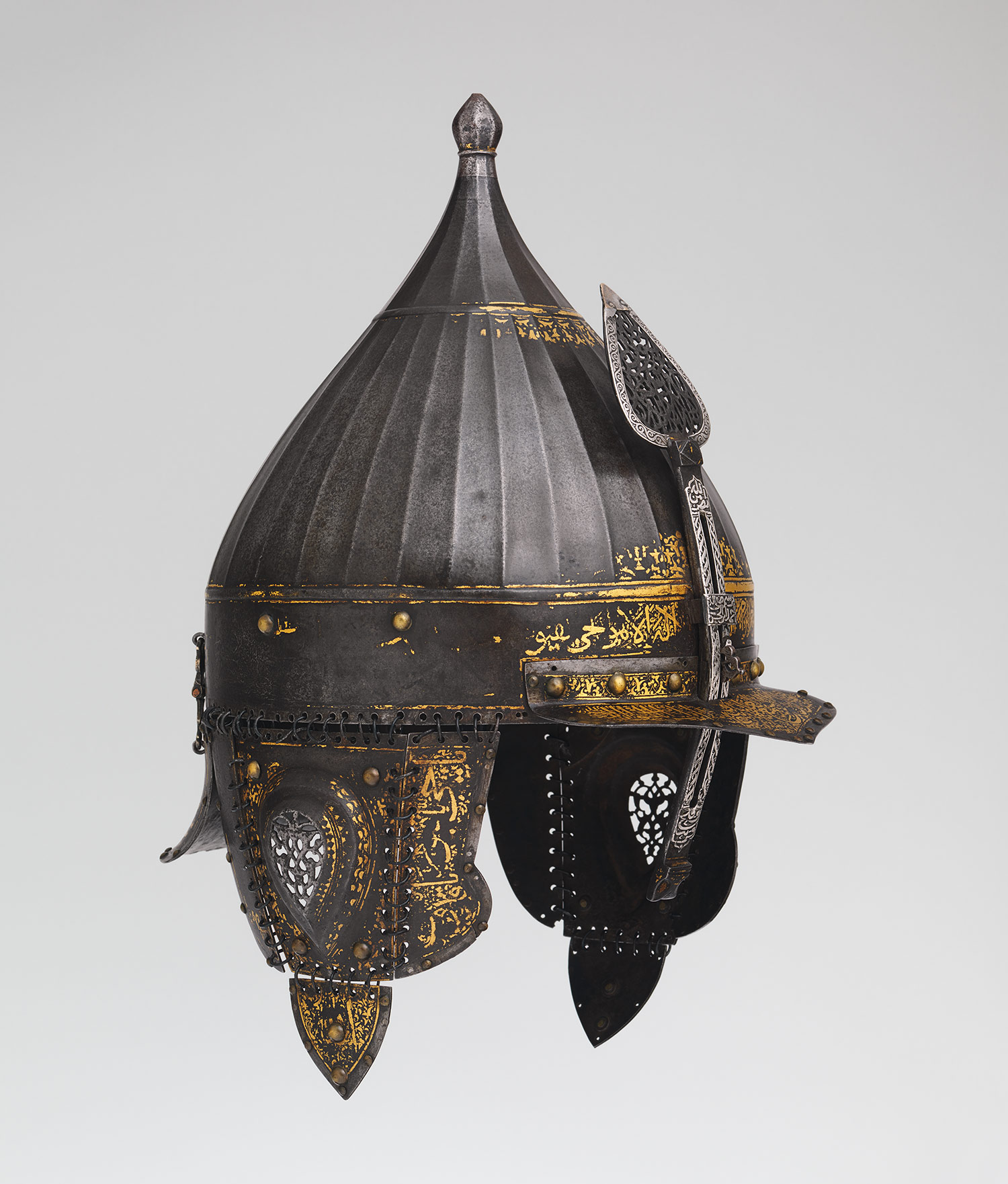
"Ottoman Helmet," 16th century,
Metropolitan Museum of Art, 04.3.456a
"Ottoman Style Helmet," 16th century,
Walters Art Museum, 51.72


"Ottoman Style Helmet," probably Nuremberg,
16th century, Hungarian National Museum, inv. 55.3346

Sunday, July 29, 2012

Sixteenth-century Pashas of Buda


It is difficult to come across a list of the Pashas of Buda, and I have yet to find one in English. Below you will find a list of the Pashas of Buda during the sixteenth century.1 Frequent changes in power were necessitated by political instability, assassinations, and a need for military prowess. As you will see, many Pashas served multiple times.

1. Suleyman Pasha – 1542
2. Little Ali Pasha – 1542-1543
3. Yahya Pashazade Mehmed Pasha – 1543-1548
4. Kasim Pasha – 1548-1551, 1557-1558
5. Hadim Ali Pasha – 1551, 1556-1557
6. Toygun Pasha – 1553, 1558-1559
7. Haci Muhammad Pasha – 1557
8. Güzelce Rüstem Pasha – 1559-1563
9. Zal Mahmud Pasha – 1563-1564
10. Iskender Pasha – 1564-1565
11. Arslan Pasha – 1565-1566
12. Sokollu Mustafa Pasha – 1566-1578
13. Kara Oveys Pasha – 1578-1580
14. Kalaylikoz Ali Pasha – 1580-1583, 1586-1587
15. Frenk (Hassan) Jusuf Pasha – 1583-1586, 1587-1588
16. Ferhad Pasha – 1588-1590
17. Sufi Sinan Pasha – 1590-1592, 1595
18. Muhammed Son of Sinan Pasha – 1592-1593, 1594-1595
19. Hasan Son of Muhammed Pasha – 1593-1594
20. Mihaliclu Ahmed Pasha – 1595, 1596, 1597-1598
21. Ali Pasha 1596-1597
22. Div Suleyman Pasha 1598-1599
23. Lala Mehmed Pasha 1599-1600

1For the earliest iteration of this list see Gévay, Antal. A Budai Pasák. Vienna: Strauss, 1841 (available on Google Books for free).

Sunday, February 26, 2012

The Ferenc Wathay Songbook

This post comes from my current research and serves to introduce a manuscript to an English-speaking audience while also offering some preliminary observations and avenues for further exploration. Just slightly outside of my own cutoff date of 1600, this unique and important product of the Ottoman-Hungarian cultural exchange deserves attention.

Figure 1
Nándorfehérvár (now Belgrade, Serbia), The Ferenc Wathay Songbook, Magyar Tudományos Akadémia (K 62, previously M. Cod. 4rét 29), folio 23b-24a


Figure 2
Temesvár (now Timişoara, Romania), The Ferenc Wathay Songbook, Magyar Tudományos Akadémia (K 62, previously M. Cod. 4rét 29),  folio 30b-31a


The Ferenc Wathay Songbook, preserved in the Magyar Tudományos Akadémia (K 62, previously M. Cod. 4rét 29), contains two remarkable city views of Nándorfehérvár (now Belgrade, Serbia)[1] and Temesvár (now Timişoara, Romania) and a host of intriguing illuminations depicting Ottomanized life along the frontier. The 133 folio manuscript, written and illuminated in 1604-6, contains twenty-eight Hungarian ballads with accompanying illustrations, followed by a twenty-four page autobiography detailing the events of the author’s life, capture, and slavery. The text and images were crafted by a member of the Hungarian lesser nobility, Ferenc Wathay, who was held as an Ottoman captive between 1602 and 1606.  Below, I provide an overview of the contents of the volume and a list of illuminations and their accompanying text, translated from the original Hungarian by myself, or left in the original Latin. Below that, I provide a preliminary list of future topics of exploration, some of which may be taken up as future posts.


Contents

3a -- title page
4a-5b -- introduction
6a-105b -- songs
107a-131b -- autobiography
132a-133a -- various remarks

Images and accompanying inscriptions

2a – coat of arms with the inscriptions:

 “This is my coat of arms, this is my Christ. 1605.
“Written by the hand of F. Wathaj”

7b – simple ink drawing of a castle

9a – a crow on a mountain

10a – a lion in a green field

 23b-24a – Nándorfehérvár city view from the river (figure 1)

“From the south, this is how the good Nándorfehérvár looks
More beautiful places do not exist on this earth
That it was taken from the Hungarians, what a shame”

27a – slaves in front of a building

Figure 3
Wathay in chains by the Temes River, The Ferenc Wathay Songbook, Magyar Tudományos Akadémia (K 62, previously M. Cod. 4rét 29),  folio  27b


27b – a castle in the background with the Temes (Romanian: Timiş) River in front of it, Wathay in chains being carried in the foreground

30b-31a – Temesvár city view (figure 2)

"This is how the sun rose, and to the South lies Temesvár
The little Temes River contains and is surrounded by mud
I did not know, and I too wait as a captive. 

31b – illustration to the autobiography - the torture of Wathay at Ferhát hodzsa

“This was how Ferhat hoddzsa (Turkish: wise man)’s hospitality ended
At Temesvár, I broke with him
Three locks, and I ran”

33b - Turkish horsemen accompanying Wathay barefoot towards a fortress

35b – transporting Hungarian slaves in a cart illustration to the biography with inscription

"As such sixty new ones, ten carts of slaves
They took us under, with great chains on our necks
In one month I will see the ruler’s home and the sea"

37b – a boat on the sea, in the background a town.

"Prior Pars Asia
Olim Bithinia
Nuc apata”

42a – a town, foreground with the sea with boats and fish

"Finis Europae
Olim Tratia
nuc pars Constantinapolis.”

44a – slaves in a basket on the back of a camel

Figure 4
Countryside with two towns, The Ferenc Wathay Songbook, 
Magyar Tudományos Akadémia (K 62, previously M. Cod. 4rét 29),  folio  44a-45b


44b- 45a – countryside with two post-raid villages completely pillaged and burned

52b – Turkish galley ship on the sea

71a – nude female standing on a wheel with wings on her heels

“Fronte Capillata Post Haec est Ocasio Calva”

72b – stag on its hind legs

“Tempora Labvntvr sic nos Ibimvs Ibitis Ibvnt”

74b – Wathay looking through the bars locked in a tower

80b – fighting bear and tiger

Figure 5
Wathay crying in his cell, The Ferenc Wathay Songbook, 
Magyar Tudományos Akadémia (K 62, previously M. Cod. 4rét 29),  folio  83b

83b – Wathay crying in his cell

“Psal Cii Factvs svm Sict Nocticorax in Domicilio.”

86a – nude male with a skull and leg bones

“O Homo Memento Quod Pvlvis es et in Pvlvere Reverteris”

87a – the last judgment

“Svrgite Mortvi Venite Ad Ivdicivm”

91a – colorful flower

100a – hunting scene with fox and crow

101a – roosters and crows with a fox

106b – dead deer with a crow on top of it with two other crows flying above

“Sic Transit Gloria Mvndi”


Some future research topics

* Ottomanization as depicted in 23b-24a (Nándorfehérvár) and 30b-31a (Temesvár)
* genealogy of the visual vocabulary
* mixing of languages in the text
* the significance of the crow and other animals
* depiction of battle scenes
* representing the Hungarian/ representing the Ottoman in image and text
* the visualization of architecture
* cruelties of war
* how Wathay acquired the tools to make this volume and how it survived
* the last judgment scene 

For a scan of the full manuscript see here.
For the text of the songs in Hungarian see here.


Bibliography

(Ács 1979)
Ács, Pál. 1979. “Wathay Ferenc: Áldott filemile. Allegória és invenció.” Irodalomtörténeti Közlemények 83 (2): 173–186.

(Wathay and Katona 1976)
Wathay, Ferenc, and Tamás Katona. 1976. Wathay Ferenc énekes könyve [Ferenc Wathay's song book]. Budapest: Magyar Helikon.

(Benda 1968)
Benda, Kálmán. 1968. “Adalékok Wathay Ferenc életéhez.” Irodalomtörténeti Közlemények 72 (2): 211-213.

(Nagy 1957)
Nagy, Lajos. 1957. Wathaz Ferenc: Székesfejérvár veszérül való história. Székesfejérvár: István Király Múzeum.

 (Angyal 1955)
Angyal, Endre. 1955. “Vathay Ferenc énekeskönyve.” Irodalomtörténeti Közlemények 59 (1): 51-61.
 
(Nagy 1955)
Nagy, Lajos. 1955. Wathay Ferenc énekeskönyve [Ferenc Wathay's song book]. Székesfehérvár: István Király Múzeum közleményei.


[1] The image of Nándorfehérvár was incorrectly bound. Without access to the manuscript itself, I cannot be sure when this mistake was made. Contemporary images of the city reveal its shape as I switched it in Figure 1.

Saturday, November 19, 2011

The Construction of the Urbis Corviniana: History and Role of the Architectural Treatise in Fifteenth Century Hungary (Part II)


This is the second part of the October 2011 entry, based on a paper I wrote for Professor Tod Marder at Rutgers on Architectural Treatises in the fall of 2009. I aim here to address the actual presence of humanists and architects at the court of Matthias Corvinus and then relate their presence to the presence of the written architectural treatises.

                Humanism at the court of Matthias Corvinus, developed in two distinct phases: the first is associated with his childhood tutors from the early 1450s through 1472, and the second with his marriage to Beatrice d’Aragon from 1476 through his death in 1490.  Through these two periods Matthias developed his surroundings into an early Renaissance court modeled on Florentine traditions.
                  Matthias Corvinus was born Matthias Hunyadi in the Vajdahunyadi Castle in Transylvania to John Hunyadi, a well-known general rewarded by the King for his successes with several estates.  Because of their wealth, the family imported two scholars, first Gregory of Sanok and then János Vitéz, to tutor the young Matthias and his older brother.[1]  Gregory of Sanok, a Polish scholar heavily involved in the study of Virgil, provided him with a strong background in Latin.  At around the age of ten, János Vitéz, also an active Latin scholar, took over as primary tutor to the boys.   Although Vitéz never traveled to Italy, he studied at the Unviersity of Vienna and had relatives and friends in Florence, Parma, Rome, and Urbino.[2]  Vespasiano da Bisticci, the well known Florentine bookseller whose memoirs offer valuable information on fifteenth century Florence, commended Vitéz for importing “the most learned men of Italy” while also introducing “many painters, sculptors, and woodcarvers and men of every art, thereby elevating his country, which up to his time had been in a backward condition.”[3] While he was in correspondence with a number of major humanists of his day, his interest in architecture is undocumented. Therefore, while he was a major part of the humanistic revival in Hungary, it is unlikely that he was a conduit for the transfer of the all’antica style in architecture. 
                Instead, it was János Vitéz’s nephew, Janus Pannonius, who had direct connections with the humanists involved in the treatise projects in the 1450s and 1460s.[4]  As the most well known humanist to come from the Kingdom of Hungary, Pannonius’ was praised by Cosimo di Medici as the most intelligent “ultramontane he had ever met.”[5] While studying at the School of Guarino da Verona in Ferrara between 1447 and 1458, he learned Latin and Greek , moving on to complete his education at the University of Padua in canon law.  He made an educational tour of Rome and returned to Hungary in 1458 to serve the newly elected king as Bishop of Pécs.  In 1465, he returned to Florence as part of a delegation sent by the King to seek more funding and support against the Ottoman Turks. During this trip, he made time to purchase books and socialize with his old humanist friends.  Vespasiano da Bisticci’s memoirs note that, “Giovanni was one of the most estimable men this country ever produced, as will appear in his Life,” and that “no Italian of his age was his equal.”[6]  During the same visit to Florence, he sat in on lectures and met with his friend Poggio Bracciolini, leader of the Florentine Neo-Platonic circle.
                The importance of Janus Pannonius’ connections to humanists involved with the classical architectural revival in Hungary has yet to be addressed in the scholarly literature. While in Ferrara between 1447 and 1458, Pannonius may very well have encountered Alberti’s theories, particularly since it was the location where Alberti himself was writing just five years earlier.  In Rome, he likely encountered the plans for Saint Peters Basilica, along with the many other building projects undertaken that decade.  Pannonius’ friend, Bracciolini, was one of the early Italian humanists to get involved with Vitruvius, and it was he who “rediscovered” the text in a monastery in Saint Gaul around 1416. It was also Pannonius who convinced some of his finds from his days of schooling in Ferrara to join him at the Hungarian court.  Such was the case with Galeotti Marzio, who was put in charge of building and maintaining the Corvina library.[7]  
                This meeting with the Poggio Bracciolini, his eleven years in Ferrara, his tour of Rome, and the time spent in Florence undoubtedly left an impression on the young Hungarian, and although his surviving correspondences do not mention architecture, the blossoming of Renaissance architecture in all of these locations would have been impossible to ignore.
                In addition to Vitéz and Pannonius, a large number of Hungarians lived in a humanist colony in Florence under the direction Pétér Garázd.[8]  These scholars were actively involved in Marsillio Ficino’s Neo-platonic academy and developed friendships with members of the most important families in Florence.  In 1469, Lorenzo de Medici sent a pair of lions to Matthias at the recommendation of one of these men, in what Pajorin considered an effort to invoke the imperial title.[9]  Many of these scholars regularly corresponded with Vitéz about the newest happenings in the rapidly evolving Florentine humanist culture.  Any of these Hungarians living in Italy may have reported on developments in architecture that would have influenced the King’s patronage.
                 This exchange during the first period of Renaissance humanism in Hungary was not limited strictly to humanists, and concurrently with these activities discussed above, a number of architects and artists communicated with and traveled to the Hungarian court. The King had unique needs for advanced military architecture to hold back the Turkish armies to the South, and for these reasons, he came into contact with the Florentine architect Michelozzo di Bartolomeo (1396-1472) in 1464 and 1466.[10] Michelozzo, the designer of the Palazzo Medici Riccardi and one of the architects associated with the remodeling projects at the Palazzo Vecchio, was a leading architect of his day.  In a letter discovered by Péter Farbaky, Michelozzo offers his services to the king and discusses, among other things, a hydraulic pump that could be used in the King's gold and silver mines.[11]  The work eventually undertaken by Michelozzo for Matthias cannot be securely attributed, but some scholars place him in Dalmatia in the late 1460s working on a series of defensive walls and fortresses.[12] 
                Scholars examining the Renaissance architecture of Hungary have also neglected to emphasize the significance of Matthias Corvinus’ connections to the Sforza in Milan in the mid 1460s.   Filarete finished writing his treatise for Francesco Sforza at his court in Milan around 1464, the same year that Matthias began marriage negotiations with Francesco for the hand of his daughter, Maria Ippolita.[13]  Although the plans fell through due to Venetian and papal intervention, the Sforza and Corvinus remained connected through the exchange of architects and humanists in the following years.   In 1466, five master masons sent by Gian Maria Sforza, Duke of Milan arrived in Hungary to carry out the plans of the Dalmatian military engineer Paschoe Michelievich.[14] These architectural projects have also been linked to another Bolognese architect: Aristotile Fioravanti a military engineer of the Sforza who spent six months in Hungary.   What sort of connection would these master masons from Urbino have had with Filarete? How much of the principles in his treatise were already widely used in the court? It is highly probable that during this period, Matthias or some members of his court had some second hand knowledge of the Filarete treatise.  Although he did not receive his copy until 1489, Matthias was in all likelihood aware of Filarete’s treatise, or at least the principles contained therein, as early as the mid 1460s when it was first written.
                It would be safe to call this first period of humanistic activity modest in comparison to the one that followed it.  The books collected by Vitéz and Pannonius were commissioned with scholarly intentions, their margins frequently filled with notes and translations.  While the architectural constructions are more difficult to date than the manuscripts, it is safe to say that they were more ambitious than accurate and on a smaller scale, with the larger projects mostly confined to military architecture.  This first phase ended with the deaths of Janos Vitez and Janus Pannonius who, due to political disagreements associated with the wars against the Turks and the Poles, were part of an attempt to poison the King in 1472.  The King, in turn, became temporarily hostile towards the Humanists with connections to Italy, and according to the writings of Ludovico Carbone of Ferrara, Matthias banned Italian from his court after the plot.[15]  The second phase of Humanistic activity, far more grandiose than the first, was ushered in four years later with the arrival of Matthias’ new Neapolitan wife, Beatrice d’Aragon.[16]
                Beatrice d’Aragon, second daughter of King Ferdinand of Naples, was raised in a bustling humanistic court of her own and had grown accustomed to the luxuries of Renaissance Italian culture.  She arrived at the court with a large number of scholars, artists, and architects from her home in Naples and across the Italian peninsula in 1474 and was particularly well known as a patron of musicians.  Little research has been done on her artistic patronage at the court alongside her husband, but her influence and that of her large retinue is undeniable, and it was they who shaped the course the remaining fourteen years of art and architecture in Matthias era Hungary.[17]   The most important humanists that joined her at the court in Buda were Bandini  and Bonfini.
                Francesco Bandini de Baroncelli of Florence arrived in the retinue of Queen Beatrix of Aragon in 1476.[18]  As a former pupil of the school in Ferrara, and a good friend with Marsilio FIcino, Bandini has traditionally been seen as the closest link between the Neo-Platonists in Florence and the court in Buda.
Feuer-Tóth first suggested that Bandini was Matthias' chief counselor on architectural matters.[19]  Hajnóczi, who re-evaluated Bandini’s position in light of his known publications and letters, questioned this notion.  Hajnóczi determined that Bandini had a background in the theoretical side of architecture prior to his arrival in Hungary. His short publication describing Naples as the ideal city, Hajnóczi suggests, was based loosely on Filarete’s treatise,[20] and was possibly the reason why Bandini returned from a from Florence in 1488 with a borrowed copy of the Filarete treatise, even though the Hungarian court already had an Alberti in its collection.[21]  Scholars have often taken as conscious act by which he intended to convey to King Matthias the knowledge of classical Roman antiquity and the right proportions of buildings.  Curiously, Bandini once wrote, “God forbid that I should go to Hungary,” and yet after spending almost fifteen years in Buda, his fame today rests not in his humanist writings, but on his role as intercessor between Florence and the Hungarian royal court.[22]
                  Although the importance of his role in the dissemination of renaissance architecture in Hungary is indisputable, I believe he was not the first to introduce the ideas of Filarete to Matthias.  He was, however, the first to introduce the physical text of the Maglebechianus codex to the King.  We know from the dedication of the Latin translation of the text, that Matthias was so impressed with the images in the manuscript that he immediately ordered work to begin on a new set of buildings and a bridge.  In the meantime, he commissioned another court humanist, Antonio Bonfini, to translate Filarete’s Italian into Latin, a language the King had spoken since childhood. 
                The scholar Matthias chose to complete the translation was no stranger to architectural theory himself.  Antonio Bonfini, who first came in contact with the Hungarian court in 1476 during the wedding celebrations of Matthias and Beatrice, arrived at the court ten years later in the fall of 1486 as a reader to the Queen.  Bonfini’s earlier connections to architectural theory had not been emphasized until Maria Beltramini’s introduction to the publication of his Latin translation in 2000, which suggests that Bonfini met and befriended Di Giorgio in Urbino, while he who was working on his architectural treatise. [23]  Shortly after his arrival at court, Bonfini caught the attention of the King and was soon engaged in writing a new history of the Kingdom of Hungary, the Rerum Ungaricum,  which included a significant amount of description on the patronage of Matthias.[24]  The translation of Filarete’s treatise, begun in 1488 and completed in three months, resulted in a heavily edited version of the original, filled with Bonfini’s own corrections and omissions.  Bonfini’s own understanding of the metope and tyrgliph replaced that of Filarete’s, and many anecdotes taken from Vitruvius were restored to their Vitruvian Latin rather than the confusing Italian translation.  In the preface, he praised Matthias’ past architectural achievements and wrote that the translation was undertaken because the King was so impressed with the pictures.[25]  He also states that the King wanted to understand correct proportions and build some of the works in his own Urbis Corviniana.[26]  Yet, as we know, the most up-to-date proportions and columns were already in use by the early 1480s.
                The plans for the new constructions ordered by Matthias upon seeing the were never completed and their plans do not survive.  All that is left to suggest any work actually begun on the projects is a puzzling description of a plan in the writings of Gaspar Heltai from 1575.[27]  Scholars did not always believe the description and most considered it just a dream of Heltai, who was writing during the Ottoman period when the precious buildings described by Bonfini were being replaced with mosques and minarets.  The first scholar to identify the description with Filarete was Bierbauer Virgil, who did not take the plan itself seriously, but suggested that the idea itself may have come from Filarete.[28]  Only recent scholars have taken a closer look at the written and archeological evidence to reevaluate the Heltai’s claims.[29]  Kulcsár Péter found the Latin text on which Heltai’s description was based, written in 1521.[30]  From then scholars began to speculate on the location of the planned buildings, suggesting possible excavation sites. In her article on the subject, Feuer-Tóth makes the argument that Bonfini gave a precise translation when it comes to the house of Virtues and Vices, which she suggests was an instruction from the King himself.[31]  She locates the foundations of a circular building underneath Fő and Iskola utca,[32] and suggests that Heltai did not understand the plans he was describing, or cardinal directions, which have led to much of the confusion.  She also suggests that based on his descriptions,  the manifestation of the plan would be reminiscent of the painted panels of Piero della Francesca from Urbino by and the intarsia panels in the studiolo.  The extent of planning and foundations built may never be uncovered, but it is clear that the visual aspects of the Filarete treatise sparked an even greater interest in building new structures.
                In addition to Bandini and Bonfini, this second period of humanistic activity at the court of Matthias was also characterized by an influx of Florentine architects and workers who greatly shaped the outcome of the building projects.  Of these, the most important is the master architect Chimenti Camicia, who signed a contract in 1479 with a group of Italian workers to continue the building projects in Buda.[33] His five woodworker-craftsmen were Johannes Antonius Dominici, Vectorius Petri Simonis, Bartolomeo del Citto, Albizus Laurentii, Dominicus Dominici of Prato.
                Thanks to the archival research done by Peter Farbaky, two publications in the last four years have shed new light on this important figure in Hungarian Renaissance art.[34]  Camicia, a woodworker turned architect spent the second half of the 1450s working in Rome, possibly as a sculptor inside the Sistine Chapel.  After returning to Florence he owned a woodcarving shop from which his name disappears in 1470. Farbaky has suggested that his arrival in Hungary may date as far back at 1470. From the wording of the 1479 contract, it is indicated that Camicia was already actively working in Hungary for some time.  The contract from 1479 lists five other workers: one from Prato, two from Florence, and two from unknown locations.  As chief architect, Camcia orchestrated a majority of the building projects under Bandini. Farbaky suggests that the cross mullioned windows which feature prominently in Hungarian Renaissance architecture are likely products of Camicia’s stay in Rome. 
                Another fellow Florentine, Baccio Cellini, accompanied the group and led an intarsia workshop that outfitted the castle with ceilings and wall panels modeled on those in Urbino.  These intarsia panels and the ideal perspectival cities they depict have been linked by scholars to Filarete’s presence at the Urbino court.[35]  None of his works survive. One can only imagine how the presence of the intarsia panel maker, the craftsmen, the architect, and the humanists, all with close ties to the court for which Filarete produced his treatise, shaped the course of Renaissance architecture in Hungary without the need for an architectural treatise.
Between Theory and Practice
                In conclusion, the early development of Hungarian Renaissance architecture occurred without the presence of a treatise on classical architectural.   The building projects in Visegrád, with its colonnaded courtyard, classicizing windows and doorframes, and all’antica decoration, was completed between 1474 and 1484, years before Alberti and Filarete’s treatises arrived into the Corvina library.  Their acquisition was not the catalyst in a new architectural movement, but more of an artistic and humanistic pursuit themselves.  Their margins were filled with illuminated coats of arms and elaborate decorations, not notes and drawings of an architect trying to work out a theory.  If their arrival proved one thing, it was that the power of visual representations was far more effective than the written words.  Matthias was not impressed by Filarete’s prose, nor his detailed measurements, which are not particularly extensive. He did not even read it because it was in Italian.  Instead Bonfini’s introduction states that the King held the book in his hands, saw the images, and said ‘I want that!’  He used it as a pattern book and wanted it translated so that he could read the descriptions of buildings he was interested in commissioning for his projects on his Urbis Corviniana, a parallel to Sforzinda that had been in the works since the 1460s.


[1] For an overview of the early education of Matthias see Klára Pajorin, “The First Humanists at Matthias Corvinus' Court, the Early Inspirers of Flaunting Wealth and Power,” in Matthias Corvinus the King: Tradition and Renewal in the Hungarian Royal Court 1458-1490, ed. Nicolas Bodoczky (Budapest: Budapest History Museum, 2008), 139-145.
[2] The most recent publication on his humnaistic actities is Ferenc Földesi, A Star in the raven's shadow: János Vitéz and the beginnings of humanism in Hungary (Budapest: National Széchényi Library, 2008).
[3] Vespasiano da Bisticci, W. G. Waters, and Emily Waters, The Vespasiano memoirs: lives of illustrious men of the XVth century (Toronto: University of Toronto Press, 1997), 189.
[4] Janus Pannonius’s original name was János Csezmicei, but once he spent time in Italy, he changed his name to reflect his interest in classical antiquity.  Pannonia was the name of the Roman province that once occupied the lands where the Hungary was located.
[5] (Vespasiano 1997, 187)
[6] (Ibid. 192)
[7] (Csapodi 1973, 39-40)
[8] Albert Hangácsi, István Várdai, Nicolaus Barius (Miklós Bánfalvi) and others.
[9] (Pajorin 2008)
[10] Péter Farbaky, “Chimenti Camicia, a Florentine woodcarver-architect, and the early Renaissance reconstruction of the Royal Palace in Buda during the reign of Matthias Corvinus (cca. 1470-1490),”  Mitteilungen des Kunsthistorischen Institutes in Florenz 50: 215-256.
[11] This unpublished letter was discovered by Péter Farbaky in the Florentine archives (Ibid., 218).
[12] Harriet Mcneal Caplow, "Michelozzo at Ragusa: New Documents and Revaluations," The Journal of the Society of Architectural Historians 31, 2 (1972): 108-119.
[13] For more on the marriage contracts of Matthias see Orsolya Réthelyi, "King Matthias on the Marriage Market,” in Matthias Corvinus the King: Tradition and Renewal in the Hungarian Royal Court 1458-1490, ed. Nicolas Bodoczky (Budapest: Budapest History Museum, 2008), 247-249.
[14] (Feuer-Tóth 1981, 13)
[15] Ad serenissimum principem et inclitum Pannoniae regem divum Mathiam Lodovici Carbonis dialogus de ipsius regis laudibus rebusque gestis (Dialogue on the acts and deeds of the august Prince and illustrious King of Hungary Matthias, written by Lodovicus Carbo and addressed to the same King).  The full text of this manuscript is available online through the website of the Library of the Hungarian Academy of Sciences. The text was written as a propaganda piece with one of his Carbo’s former pupils, Bishop of Pécs Zsigmond Ernuszt, circa 1475.  The story is told from the perspective of the son of the treasurer telling a history of the patronage and activities of Matthias to date. Clearly, this ban could not have lasted too long since he married an Italian four years later.
[16] Their wedding had been in the works since 1474, and a small portion of her retinue and representatives from the court in Naples arrived as early as that winter.
[17] Her role as patron alongside her husband has been neglected by past scholars, and most refer only to the Hungarian people’s hatred of her, stemming from her spending habits, inability to produce a male heir, and refusal to accept Matthias’ only illegitimate son as her own.  Most important from the group for are Francesco Bandini de Baroncelli and Antonio Bonfini
[18] Some of the chronology of Bandini’s life had yet to be worked out.  Scholars have suggested that he was ousted from Florence in relation to the Pazzi conspiracy.  This would mean that he was in Florence until 1478, when he was supposed to have already been in Buda in 1476.
[19] Rósza Feuer-Tóth, Art and Humanism in Hungary in the Age of Matthias Corvinus (Budapest: Akadémiai Kiadó, 1990), 56.
[20] Kristeller, published seven letters and two short written pieces by Bandini. Paul Oscar Kristeller, Studies in Renaissance Thought and Letters (New York: Harper and Row, 1961), I, 395-435.
[21] Hajnóczi says two Alberti’s were already in the collection, but as discussed earlier, the second Alberti was never completed and thus never arrived at the Hungarian court.
[22] (Farbaky 2006)
[23] (Beltramini 2000, XX)
[24] Recently scholars have begun to re-evaluate these descriptions, suggesting that Bonfini may have relied heavily on classical literature and prose to make himself appear to have a better command of the Latin language.  While some scholars still considered Bonfini’s descriptions reliable such Sándor Toth, this extensive borrowing and quoting is highlighted by Árpád Mikó 1989.  Sándor Toth, "Die Gebäde des Budauer Königspalastes zur Zeit Sigismunds von Luxembourg“ in Sigismundus Rex et Imperator Kunst und Kultur zur Zeit Sigismunds von Luxemburg 1387 - 1437, ed. Phillip von Zaberan (Budapest: W-Press Kft, 2006), 200-217. Árpád Mikó “Egy stílusfordulat reinkarnációja: Antonio Bonfini építészeti terminilógiájának értelmezése,“ [The reincarnation of a stylistic turn: The interpretation of Antonio Bonfini’s architectural terminology] in Sun Minervae Nationis Praesidio. Tanulmányok a nemzeti kultúra kérdésköréből Németh Lajos 60. születésnapjára, [Sub Minervae Nationis Praesidio: Studies on national culture on Lajos Neméth’s 60th birthday] ed. staff of the Eötvös Loránd University (Budapest: Eötvös Loránd University, 1989), 37-40.
[25] “We know from Bonfini's accounts that the King was so taken by the pictures showing bridges and towns that he asked Bonfini to translate Filarete's work into Latin.” (Feuer-Tóth 1981, 18) She does not cite the location of this.
[26] An English language translation of this introduction would be a vital source on the topic.
[27] Gáspár Heltai, Gáspár Heltai magyar krónikája [Gáspár Heltai’s Hungarian Chrnonicle] (Kolozsvár, 1575), 532-533.
[28] Virgil Bierbauer, ”King Matthias Corvinus plans a University in Buda,” The Hungarian Quarterly (1938): 137-142.
[29] For the most recent publication on the topic in a traditional art historical language see Alessandro Scafi, "Filarete e l'Ungheria: l'utopia universitaria di Mattia Corvino," Storia dell'Arte (1994): 137-68.
[30] It seems likely that Heltai’s description came from an earlier Latin description and plan that was made in 1521. Péter Kulcsár, “Az óbudai egyetem Heltai Gáspár krónikájábnan,” [The University in Óbuda  from the chronicle of Gáspár Heltai] Acta Universitatis Szegediensis de József Atilla Nominate. Acta Historiae Litterarum Hungaricarum. 10-11 (1971): 5-7.
[31] (Feuer-Tóth 1973)
[32] - Kulcsar Peter suggested it was located in Óbuda, which Feuer-Tóth says goes against Heltai’s description. Apparently the plan was to make a bridge between Schola and Pest.  No matter where you place the Schola, following Heltai’s plan is impossible because the rectangular neighborhood would have to occupy an awkward trapezoidal space. She says that this proves he did not understand his cardinal directions were off.  Because of this confusion it is difficult to pinpoint the location.
[33] His name was first uncovered by Gaetano Milanese, Novi documenti per lastoria dell’arte toscana dal XII al XV secolo (Florence, 1901), 127.  The topic was not taken up again until (Balogh 1966, 53).
[34] (Farbaky 2006)
[35] (Ibid., 223-225)